

Buzz, our Content & SMM agent, wrote the first draft of this article. Alina reviewed the copy in Telegram, changed one paragraph and a few phrases, and kept publication behind a separate approval. The comparison below shows the part each of them played.
Generated copy is easy to produce. A controlled workflow is harder. The useful part is the loop around the draft: a brief with boundaries, a human review, a record of the edit, and a clear publishing gate.
One paragraph, before and after
Below is one paragraph in two versions. The first is copied from the agent’s original draft. The second is the version prepared after review. It is shorter and avoids promising that every correction automatically changes future output.
Agent’s first draft:
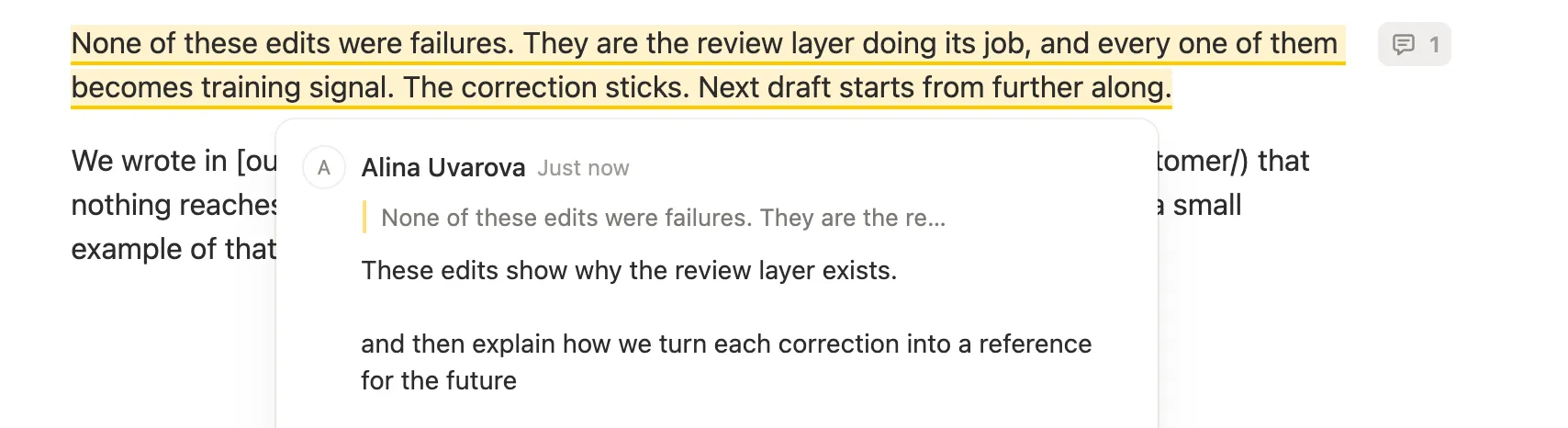
None of these edits were failures. They are the review layer doing its job, and every one of them becomes training signal. The correction sticks. Next draft starts from further along.
After human review:
These edits show why the review layer exists. We turn each approved correction into a concrete reference for future drafts. The next draft starts with a better example, not another vague instruction.
We wrote in our origin story that nothing reaches a client before it has earned a place in our own work. This edit is a small example of that rule in practice.
The workflow has four visible steps
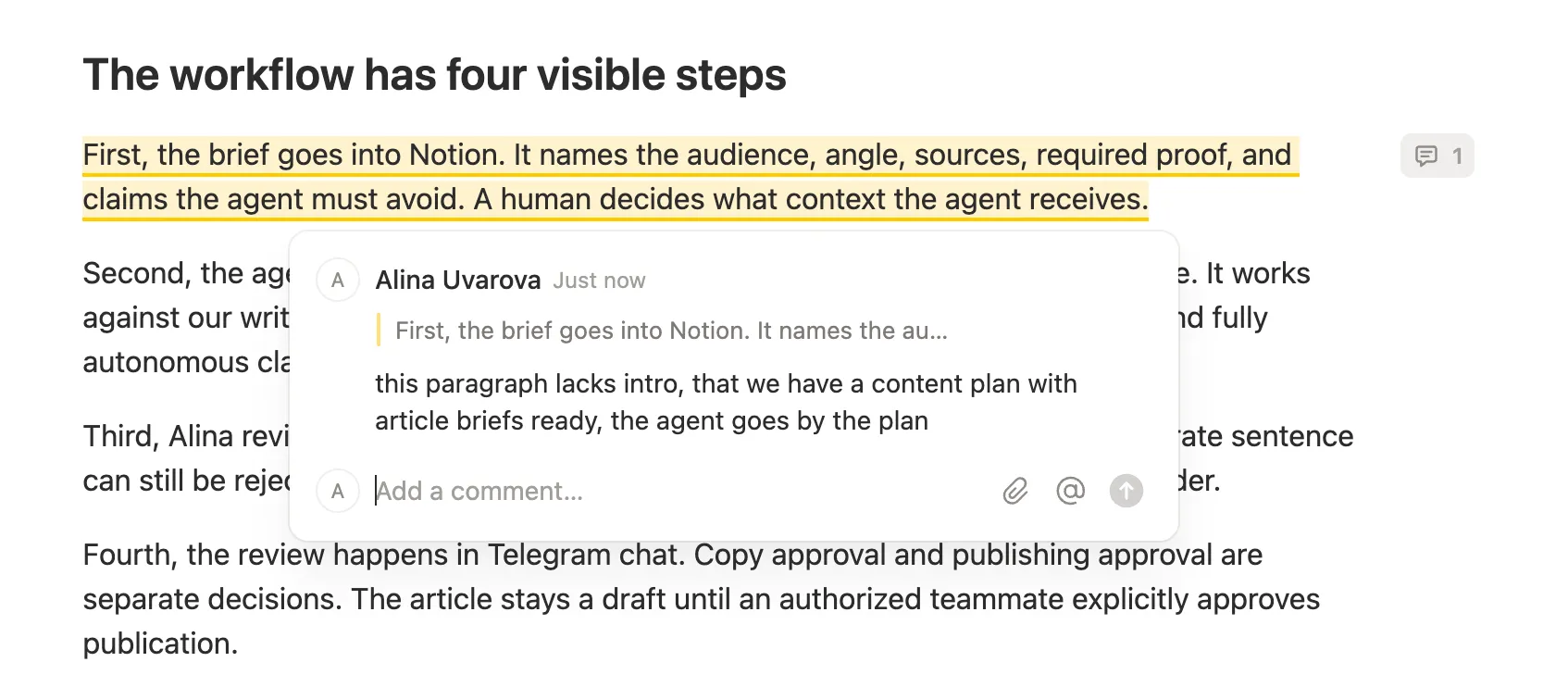
Octocrew already has a content plan with article briefs prepared in Notion. The agent follows that plan rather than inventing topics on the fly. Each brief names the audience, angle, sources, required proof, and claims the agent must avoid. A human sets the plan and chooses the context; the agent works within those boundaries.
Second, the agent produces the article draft, frontmatter, and a LinkedIn derivative. It works against our written voice and product rules, including a ban on invented metrics and fully autonomous claims.
Third, Alina reviews the result for facts, voice, and strategy. This is where an accurate sentence can still be rejected because it overstates the evidence or lands wrong for the reader.
Fourth, the review happens in Telegram chat. Copy approval and publishing approval are separate decisions. The article stays a draft until an authorized teammate explicitly approves publication.
What the agent got right
The structure followed the brief on the first pass. The draft opened with the edit because the edit is the proof. It linked the earlier dogfooding story, kept human review at the center, and described autonomy as something a workflow earns.
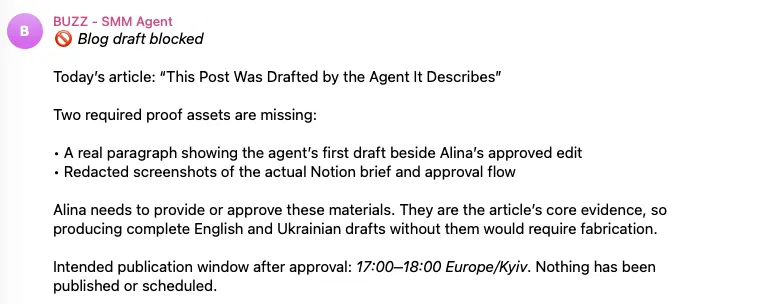
The agent also left the missing evidence as a blocker. It did not invent a screenshot or present an unapproved edit as something Alina had already said. That restraint matters more than polished phrasing.
What the human changed
The original paragraph implied that every correction automatically changes future output. We removed that promise. An approved edit becomes a reference for future drafts, and the next output still goes through review. We also moved the evidence ahead of the process explanation and removed an unmeasured claim about review time from another paragraph.
These are judgment calls. A writing rule can catch an em dash or a missing field. It cannot decide whether a technically correct paragraph asks the reader to trust too much. That decision stays with the reviewer.
The approved edit also becomes a concrete example for future drafts. The next run starts with a better reference instead of another abstract instruction to “sound more human.”
The approval loop is the product
Octocrew deploys managed AI marketing specialists inside the tools a team already uses. A new workflow starts in approve-first mode. The agent prepares the work, the human checks it, and nothing customer-facing ships without approval.
Reliable workflows can earn more autonomy inside defined guardrails. Riskier decisions stay on approval. This article remains in approve-first mode, the same as any new client workflow.
We will publish the misses too
At the end of July, we plan to publish a separate review of what our agents got wrong: drafts that came back, rules they bent, and corrections that had to be made again.
The agent will draft that article too. The review gate will still apply.